Use ChatGPT deep research to compare suppliers by defining your requirements, checking supplier sources, and requesting a cited comparison with unresolved questions. Start with the item, quantity, delivery location, and deadline. Open ChatGPT and type @Deepresearch with your request. Your finished work should be a shortlist and questions to confirm before ordering.
This guide uses ChatGPT in Chat, where research includes a proposed plan and source controls. You need access to deep research in your account and permission to share any documents you provide. The practice exercise below uses invented quotes, so you can learn the checks without uploading business information.
Key takeaways
A useful supplier comparison separates confirmed requirements, quoted costs, and facts that still need an answer from the supplier.
- Deep research combines evidence from several sources into a report with citations or source links.
- A supplier brief gives ChatGPT the same item, quantity, destination, and deadline for each comparison.
- A missing cost stays unknown until a source or supplier confirms it.
- Chat and Work use different allowances and research controls; this guide keeps their steps separate.
- The practice answer key shows why the lowest unit price can be the wrong choice.
When should you use ChatGPT deep research?
ChatGPT deep research fits a question that requires reading several sources and explaining how their evidence compares. Use ordinary search for a single fact, such as whether a supplier has a local pickup counter.
Suppose your shop needs cartons before a seasonal shipment. One supplier lists a unit price, another sells bundles, and a third only quotes freight after receiving a destination. Asking for the cheapest box without those details gives ChatGPT room to compare different purchases.
OpenAI's deep research documentation describes research across the web, uploaded files, and supported connected sources. The report includes citations or source links, but you still need to check whether each source supports the relevant claim.
| What you need | Best starting point | What you must check |
|---|---|---|
| One current supplier fact | ChatGPT search or the supplier website | The page's date and the exact item |
| A shortlist across several suppliers | Deep research in Chat | Comparable specifications and missing evidence |
| A finished comparison from quotes you already have | A spreadsheet or ChatGPT file analysis | Quantity, freight, tax, fees, and deadlines |
| Reusable instructions for future purchasing research | A ChatGPT Project | Which facts need refreshing for each order |
A citation helps you inspect an answer; it does not certify the answer. A supplier's general shipping page may describe a service without confirming that service for your item and address. Open the cited page before accepting a delivery claim.
Define the purchase before researching suppliers
A supplier brief describes the purchase in terms that competing suppliers can answer consistently. Include required specifications, order quantity, destination, arrival deadline, and the evidence you need before choosing.
If you run a café, a cup's capacity alone does not settle whether it fits your lids or suits hot drinks. Put those requirements into the brief before asking for a ranked list. Treat a missing specification as a question rather than permission to substitute a similar item.
- Name the exact item. Record dimensions, material, compatibility, and any required certification. Include an existing product reference if you have one.
- Set the buying quantity. State how many usable units you need and whether excess stock is acceptable. Bundle sizes and minimum orders affect the actual purchase.
- Set the delivery condition. Give the destination at the level required for research, plus the arrival deadline. Keep a shipping estimate separate from a supplier-confirmed delivery date.
- Choose the comparison columns. Request specifications, minimum order, goods cost, shipping, additional fees, arrival estimate, source, and unanswered questions.
- Set the action boundary. Ask for research and a draft inquiry only. Keep supplier contact, ordering, and payment with you.
For the first attempt, use public product pages or approved copies of quotes. Remove customer information, account numbers, and negotiated terms the task does not need. Review OpenAI's data controls and your business's sharing rules before uploading private documents.
Start a focused research task in Chat
Deep research in Chat lets you review the proposed research plan before the full investigation begins. Start by typing @Deepresearch in the message field and describe the result you need, as OpenAI documents.
Use this copy-and-paste instruction after preparing your purchase details:
Help me compare suppliers for one business purchase. Before researching, ask me one question at a time about the item specifications, quantity, delivery location, arrival deadline, budget, and acceptable substitutions. Wait for each answer. Then propose a research plan for my review. Use supplier product pages and current quotes for specifications and costs. Separate verified facts, supplier claims, and missing information. Do not contact anyone, request a quote, order, or pay. The final result should be a cited comparison table, a conditional shortlist, and the questions I still need to ask.
Answer the questions with your requirements. Review the plan for matching items, realistic geographic scope, and the right evidence. If the plan proposes a global list when you need local delivery, correct that before proceeding.
Keep the task small enough to inspect. Compare a few plausible suppliers against the same requirements rather than requesting an exhaustive directory. An attractive table with dozens of incomplete rows creates another review job.
OpenAI's official walkthrough shows the Chat research flow, source selection, progress, and report view. It was published in February 2026; its model name belongs to that release, while the linked current documentation governs today's availability and controls.
Video: Updates to deep research in ChatGPT, from OpenAI.
Choose sources that can answer the question
Source selection determines which evidence ChatGPT can use; it does not make weak evidence stronger. Prioritize the supplier's own product and shipping pages for factual specifications, then use independent material for questions those pages cannot resolve.
For example, if you are comparing replacement filters for equipment, a retailer's category page may mention a whole product family. The exact model page or manufacturer specification should support a compatibility claim. A review about a different model cannot fill that gap.
In Chat, OpenAI documents Sites > Manage sites in the prompt window. The resulting Search specific sites panel lets you add domains and choose between restricting research to those sites or prioritizing them while allowing broader search.
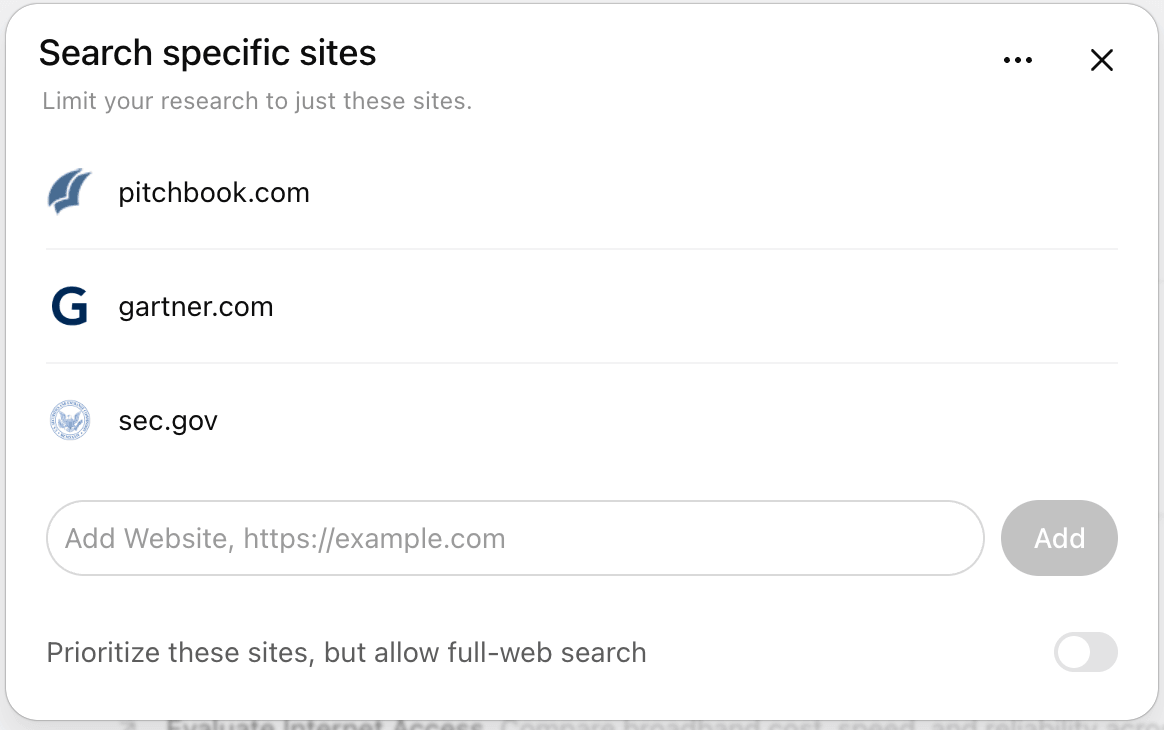
Source: OpenAI's current deep research help page, retrieved September 14, 2026. This vendor screenshot shows the destination panel, not the menu used to open it. Its example domains are not supplier recommendations.
If you cannot locate that control in your version, describe the approved sites in your written request and inspect the proposed plan before continuing. Do not assume a written preference enforces the same restriction as the source control. The official video above provides orientation for the Chat surface; Work has a different flow.
After research, open the source for each purchase-critical claim. Check that the quoted price applies to your quantity, that the item matches the required dimensions, and that the page supports the stated delivery terms. Mark missing freight or unclear availability as unresolved.
Practice with three quotes and known answers
The practice exercise tests comparison rules using three invented suppliers. The independent answer key checks costs and eligibility; it is not a tested ChatGPT response, a real quote, or proof of time saved.
Suppose you need 100 plain 12-inch cartons within seven calendar days. For this exercise only, tax is excluded equally from each quote. Real purchasing comparisons need applicable tax and other fees as well.
| Fictional quote | Price and minimum | Delivery information | Evidence problem |
|---|---|---|---|
| Supplier A | $0.72 per carton; 100-carton minimum | $24 shipping; arrival in five days | None within this exercise |
| Supplier B | $0.61 per carton; 200-carton minimum | Free shipping; arrival in ten days | Misses the deadline |
| Supplier C | $0.68 per carton; 100-carton minimum | Shipping unquoted; arrival in four days | Required size unconfirmed |
Download the practice inputs, or copy the table into your chat. Ask ChatGPT to compare the offers using the stated requirements and identify the supplier questions before recommending anything. This short exercise does not require a full web research run, because all of its evidence is in the table.
The reference calculation uses the larger of the required quantity and the minimum order. It multiplies that quantity by the unit price, then adds known shipping. A separate check tests arrival time and specification evidence. Decimal arithmetic and integer-cent arithmetic produced matching totals in the verification script.
| Reference check | Correct result |
|---|---|
| Supplier A purchase | 100 cartons; $72 goods plus $24 shipping equals $96 before tax |
| Supplier B purchase | 200 cartons; $122 before tax; arrival misses the deadline |
| Supplier C purchase | $68 goods; delivered total remains unknown; size needs confirmation |
| Eligible choice on the supplied facts | Supplier A only |
The lowest unit price belongs to Supplier B, but it requires more cartons and arrives too late. Supplier C's missing shipping does not mean free shipping. A recommendation that ignores either distinction fails the exercise even if its arithmetic looks tidy.
The downloadable answer key records the inputs' checksum, calculations, and exclusion reasons. Compare ChatGPT's result against it. For real uploaded quote tables, the sales spreadsheet analysis guide teaches a related habit: confirm the input rules before accepting a calculation.
Turn the report into supplier questions
A useful research report ends with specific questions that resolve the remaining purchase risks. Ask for a draft inquiry tied to the missing evidence, then review and send it yourself through your usual business process.
For an online shop, the inquiry might ask whether the carton price includes printing, which quantity earns the advertised rate, and what freight costs to your destination. Each question should correspond to an empty or uncertain comparison cell. Skip a broad request to tell you everything about the supplier.
Ask ChatGPT:
Review the comparison against my requirements. For each unresolved fact that could change the choice, draft one precise supplier question. Distinguish a published estimate from a confirmed commitment. Keep the shortlist conditional until the missing information is resolved. Show the inquiry drafts without sending them.
Save the reviewed comparison with its research date and source links. Before placing the order, confirm the final specification, total, availability, and arrival terms with the supplier. A report cannot establish a binding delivery promise on the supplier's behalf.
What changed in ChatGPT Work?
OpenAI's September 9 release notes added deep research to ChatGPT Work and Codex. Work research can use available web, file, and supported connected sources and create an editable result, subject to account access and tools.
The distinction matters if you already use ChatGPT Work. In Chat, research uses its own plan-dependent task allowance and offers a proposed plan with source controls. In Work, research uses your existing Work/Codex allowance or credits and asks clarifying questions after the initial request. Check your account's usage information rather than assuming the allowances are interchangeable.
This guide teaches the Chat path. The February walkthrough does not demonstrate September's Work expansion, and a connected app does not automatically support research. Keep the documented surface and your account's permissions in view when adapting the method.
FAQ
These answers cover the access and evidence questions that affect a first supplier comparison.
Can ChatGPT deep research choose the best supplier?
ChatGPT can compare evidence and propose a shortlist against your requirements. The recommendation remains conditional when delivery, price, compatibility, or other decisive facts are missing. Confirm those details with suppliers before ordering, especially when a source describes general terms rather than your specific purchase.
Do I need a paid plan?
Deep research availability and usage depend on your plan, country, and workspace. Check the controls and usage information in your account. OpenAI's documentation distinguishes Chat research allowances from Work/Codex allowances, so a limit reached in one experience does not describe all experiences.
Can I restrict research to supplier websites?
In Chat, the Sites control lets you restrict research to specified sites or prioritize them while allowing broader search. Restrictions can reduce irrelevant results, but they can also exclude useful independent evidence. Inspect the final sources and decide whether the remaining gaps need broader research.
What should I do when shipping is missing?
Keep shipping and the delivered total marked unknown, then ask the supplier for a quote that matches your destination and order size. Comparing a goods-only price with another supplier's delivered price produces a misleading ranking. Treat missing fees the same way.
Can deep research contact suppliers for me?
This workflow stops at research and draft questions. OpenAI states that deep research in Chat uses available read actions from connected apps, not app write actions as part of research. Work has different supported capabilities; do not assume its permissions match Chat's research behavior.
Should I save the result as a PDF?
Save the reviewed result in a format you can reopen and share through your normal process. OpenAI lists Markdown, Word, and PDF downloads for completed research reports in Chat. Keep source links and the research date with the document, and revisit changing claims before the purchase.
Keep learning the repeatable method
Briefing a task, choosing sources, and checking missing evidence are skills you can reuse for competitor research, equipment comparisons, and business planning. I teach those habits so the next report leaves you with less work to untangle. Use the newsletter form below for future lessons, or browse the guide library for another practical task.
One free AI workflow, every Tuesday
Each week I break down what changed in AI and walk you through setting up one workflow, step by step. Subscribers also get first notice when my academy opens.
Built for non-technical business owners. Free to join, unsubscribe anytime.

About the Author
Thomas Echezabal helps small business owners automate their busywork with AI and get real hours back each week. He has worked with small businesses his entire career, including 200+ clients on Fiverr.